


Construction Snagging: A Complete Guide With a Free Checklist
Construction snagging is the inspection of finished or nearly finished work to find defects (snags) that must be fixed before handover. Each snag is recorded with its location, a photo, the trade responsible and a due date, then closed only when a re-check shows the fix.
What Counts as a Snag?
A snag is any defect or incomplete item that does not meet the drawings, the specification or an acceptable standard of finish. Typical snags include cracked or hollow tiles, uneven paint, doors that do not close properly, missing sealant, damaged fittings and sockets that do not work. Some snags are cosmetic; others, such as a leaking joint or a loose handrail, affect safety or performance and need to be fixed first.
Snagging is called a punch list in the US. The idea is the same: a list of everything the contractor must put right before the owner accepts the work.
When Should You Snag?
- Before services are concealed: check MEP routes, sleeves and supports before ceilings and walls close. These are the most expensive problems to find later.
- At the end of each finishing stage: for example after tiling or painting on a floor, so the trade is still on site.
- Before handover: a full unit-by-unit snag of every room, then a de-snag to confirm each item is closed.
- During the defects liability period: record defects that appear after handover, with the date they were found.
A Room-by-Room Snagging Checklist
Adapt this list to your specification. Walk every room in the same order so nothing is missed.
| Area | What to check |
|---|---|
| Walls and ceilings | Cracks, uneven plaster, paint runs or patches, damp marks, straightness at corners, ceiling joints and access panels. |
| Floors | Cracked, chipped or hollow tiles (tap test), lippage between tiles, grout gaps, skirting fixing, level and slope in wet areas. |
| Doors and windows | Frames square and fixed, doors close and latch, hardware works, gaps even, glazing undamaged, seals and sealant complete. |
| Electrical | Every switch and socket works, faceplates level and undamaged, light fittings complete, distribution board labelled. |
| Plumbing and sanitary | No leaks, taps and flush work, drainage falls, silicone complete, fixtures secure, hot water reaches outlets. |
| HVAC and fire | Grilles fitted and clean, thermostats work, sprinkler heads and detectors undamaged and unobstructed. |
| Joinery and fittings | Kitchen and wardrobe units level, doors aligned, worktops sealed, no damage to finishes. |
| External and common areas | Balcony waterproofing and falls, railings secure, façade finish, lobby and stair finishes, signage. |
How to Record a Snag So It Gets Fixed
A snag that cannot be found or understood is rarely fixed on time. Every snag record should answer five questions:
- Where: unit, room and exact position, ideally pinned on the floor plan.
- What: a clear description and a photo or 360° view showing the defect.
- Who: the trade or subcontractor responsible.
- When: a due date, set by priority (safety and leaks first).
- Status: open, fixed, verified or rejected, with the date of each change.
Spreadsheets and photo folders struggle here: photos lose their location, and the list goes out of date the day it is shared. A snagging app keeps the photo, location, owner and status together, so the site team and the contractor see the same list.
Closing Snags: Fix, Then Verify
A snag is not closed when the contractor says it is fixed. It is closed when someone checks it and records evidence of the fix. Re-inspect each item, take a new photo from the same position, and mark it verified. Before and after images of the same location are the clearest proof for handover and for any later dispute.
How SitePace Helps With Snagging
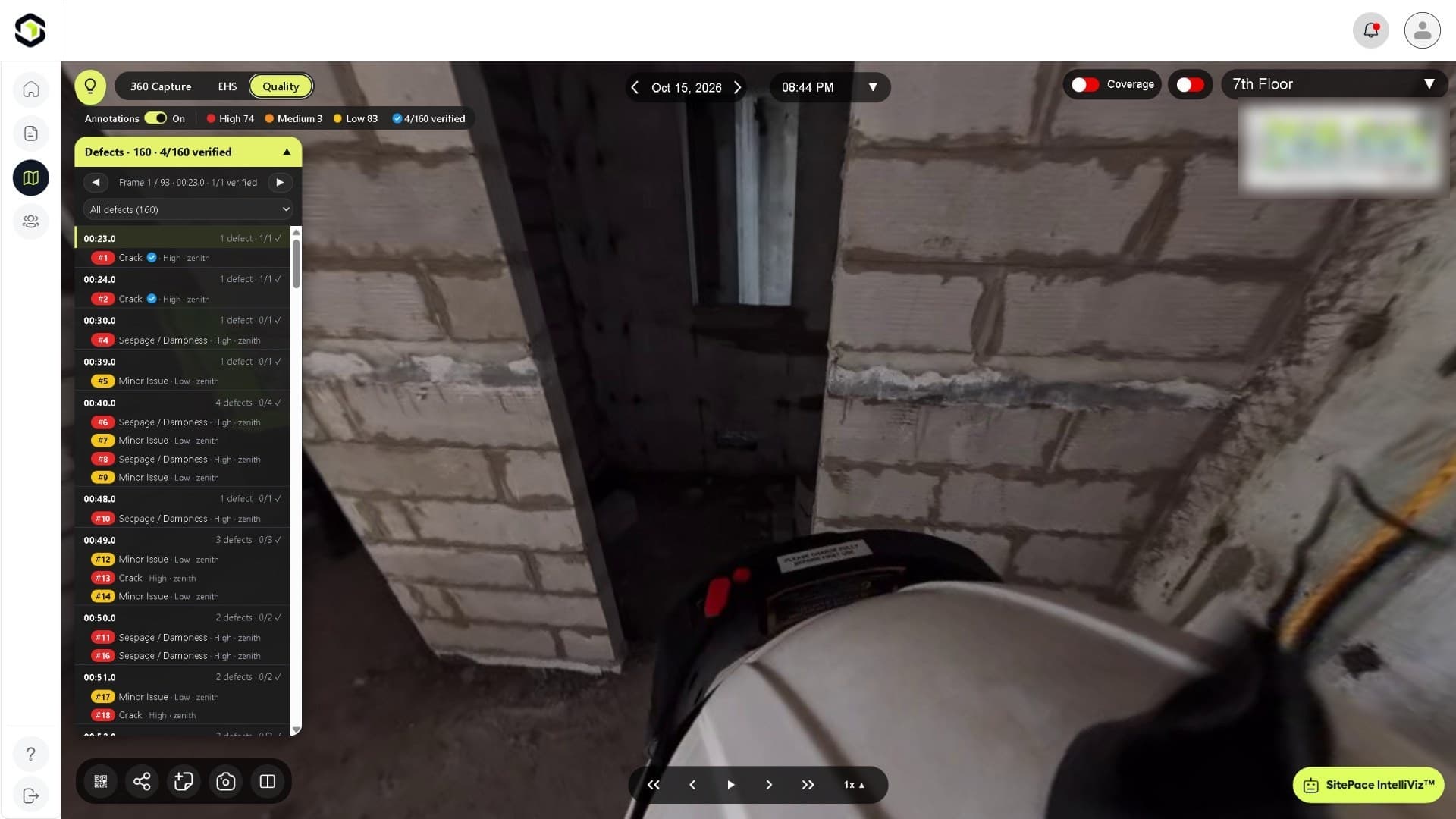
On SitePace, your team walks the site with a 360° camera and every capture is placed on the floor plan by date. AI flags likely defects for engineers to review, and confirmed snags are tracked with location, image, owner and status until a later capture shows the fix. See AI Quality Control for the full workflow.
Frequently Asked Questions
What is the difference between snagging and a punch list?
Nothing in substance. Snagging is the term used in India, the UK, the Middle East and Australia; punch list is the US term.
Who does the snagging?
Usually the contractor's quality team snags first, then the owner, the project manager or a specialist inspector does a final snag before accepting the work.
How long does snagging take?
It depends on size and finish level. Plan time for both the snag and the de-snag, and snag in stages so issues are fixed while trades are still on site.
Can AI find snags?
AI can flag likely visible defects in site images so engineers know where to look. An engineer still confirms each one, and AI does not replace physical checks such as tap tests or functional tests.
Want to see snagging run from 360° site walks? Request a demo of SitePace AI Quality Control.

